

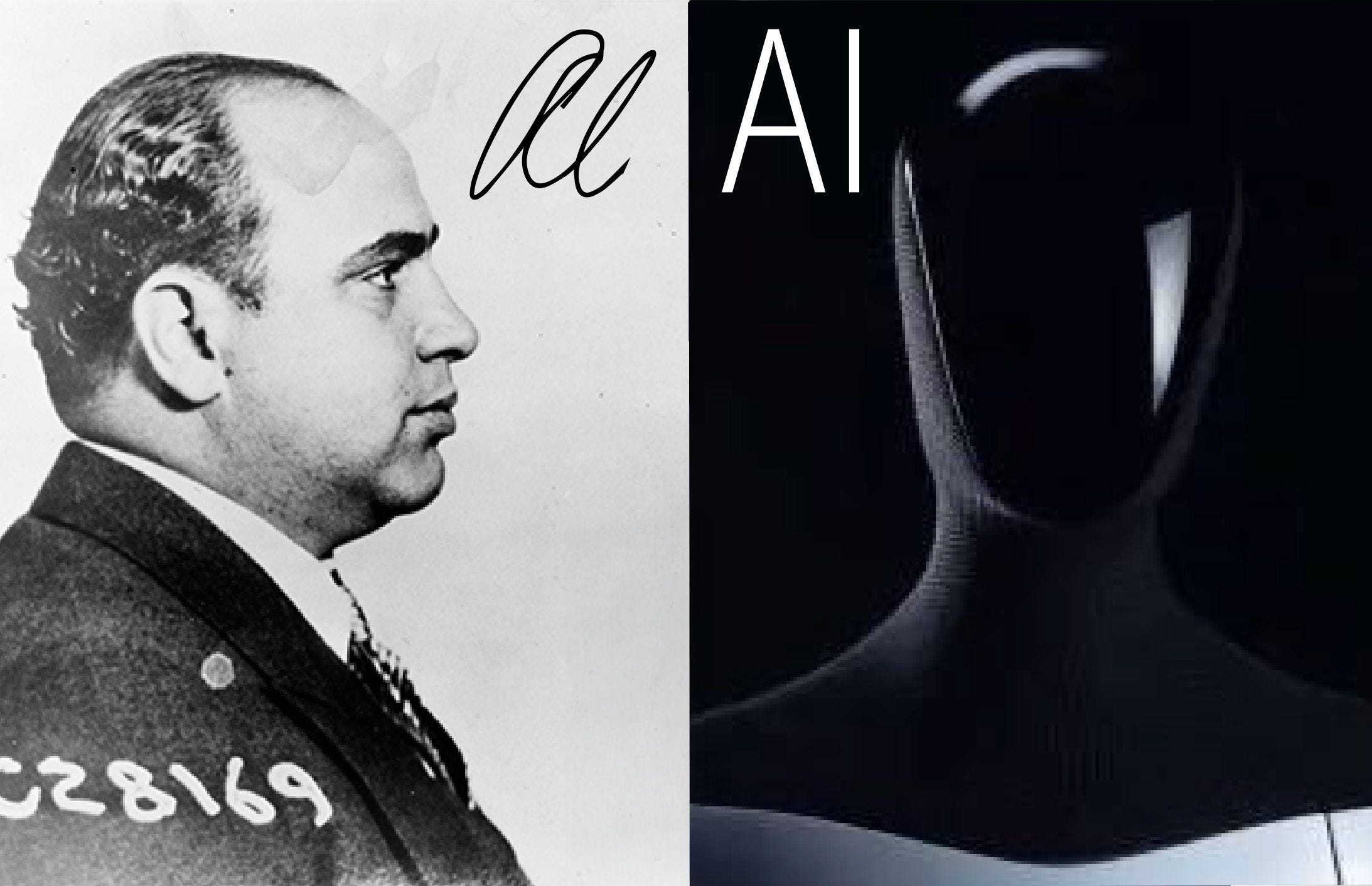
This Continuance was inspired by podcast: Courtside with Mark Ferrer Hayden, Ep #11 with Honorable Scott Silverman.
Hiding in Plain Sight
The old courthouse in Miami holds two conversations at once. One is about a man who weaponized fear and money to hollow out institutions. The other is about a force that may be doing something structurally similar at incomprehensible scale, but without malice aforethought. The building doesn’t distinguish between them. What happens if we don't either?
What is a gangster, really?
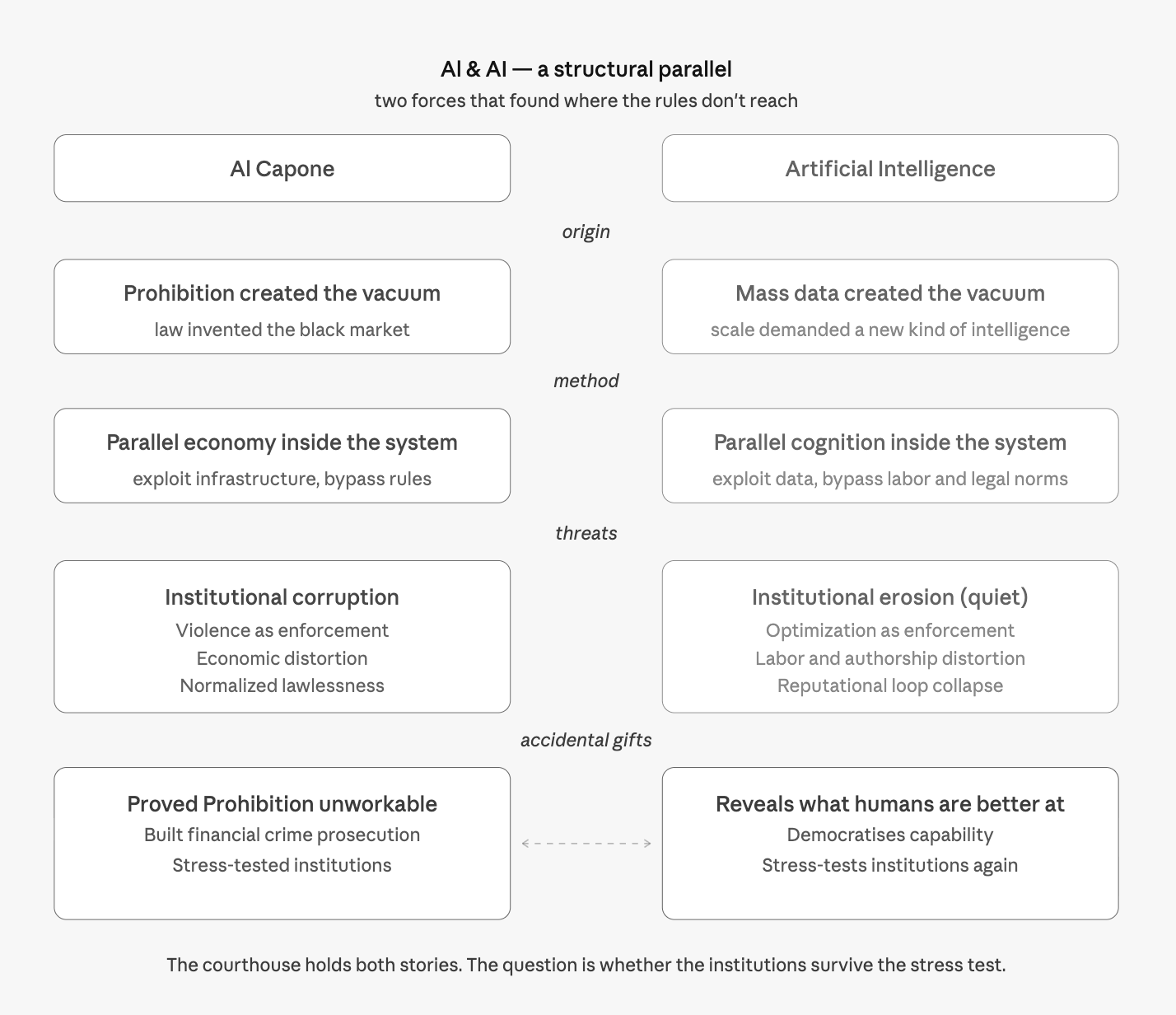
A gangster is someone who operates outside the formal system while exploiting everything the formal system built like its roads, its courts, its economics, its silence. Capone didn’t replace Chicago. He ran a parallel economy inside it, taxing the real one. Violence was the enforcement mechanism for his business model.
The core move: locate where the rules don’t reach, and build a kingdom there.
The gap doesn't care how it was made. Too much law creates a vacuum. Too little does the same. Restriction and excess arrive at the same place.
Al Capone: the threats, and the accidental gifts
The threats are well-documented. Organized violence. Corruption of public officials. Economic distortion. Bootlegging inflated the black market while starving legitimate revenue. Brutality normalized as a business tool. Institutional capture.
The gifts are less discussed, and more interesting. Capone inadvertently made the case for regulated alcohol. His empire made the costs of Prohibition undeniable in a way that no policy argument could. The soup kitchens and community feeding programs he funded, cynically, for reputation, existed nonetheless. And the tax evasion case that finally brought him down became a landmark in financial crime prosecution. The IRS became a weapon against organized crime precisely because of Capone.
He was, unintentionally, a stress test. The institutions that survived him, and those that eventually took him down became stronger for taking him on.
AI: the threats, and the gifts hiding inside
The structural parallel holds. AI is also locating where the rules don’t reach and building a kingdom there. Not out of malice, out of optimization. The threat isn’t a Capone running it. The threat is that no one is running it. AI is a distributed capture of labor, attention, creative production, and cognitive infrastructure.
The threats are familiar by now: displacement of knowledge work, erosion of authorship, concentration of capability in a handful of players, the collapse of reputational feedback loops, misinformation at industrial scale, failure at industrial scale.
The gifts are harder to see, but they're there. Expertise is more accessible. Synthesis accelerates. The friction between concept and realization disappears. Scale is no longer a limitation. And on a deeper level, AI functions as a filter and a mirror. Every time it optimizes something, it reveals what cannot be replaced. What remains; judgment, attention, relationality, meaning-making is reflected back. In this, AI is clarifying what humans are valuable for, and far better at. Like the institutions that outlasted Capone, the stress test doesn't diminish what survives it.
The Filling
Capone wasn’t brought down by the violence law. He was brought down by the tax law, by the most prosaic, bureaucratic, boring arm of the state, meticulously counting money. His downfall wasn’t as dramatic as it was clerical.
The AI equivalent won't announce itself either. It won't arrive as a ban or a sweeping regulation drafted in the aftermath of panic. It will be crafted by an accountability agent, not an FBI agent. It will arrive as a requirement. A standard. A filing. Something that creates the conditions for accountability without predetermining the outcome.
The courthouse is where the mundane and the constitutional find each other. Where the clerical becomes consequential. Where accountability discovers its address.
Footnote:
Miami’s historic Dade County Courthouse, located at 73 W. Flagler Street is now preserved, replaced by a modern courthouse, the Osvaldo N. Soto Miami-Dade Justice Center, located at 20 NW 1st Ave, Miami, FL 33128.
This essay is written and edited by Katja Maas, developed in conversation with Claude AI.
A more detailed breakdown of process is in development.
Watch the podcast episode that inspired this post.